| Nigeria | Ebok |
| Working interest | 60% |
| Partner | Afren |
| Gross 2P certified reserves (31/12/09) | 106.2 mmbbls* |
| Prospective resources | 117.7 mmbbls* |
| Work Programme | Production/Development/Exploration drilling |
*Source: NSAI
Background
The Ebok Field (Ebok) was awarded to Oriental in May 2007 by the ExxonMobil / Nigerian National Petroleum Corporation (NNPC) Joint Venture. The farm-out was structured such that the field benefits from the Nigerian Marginal Field Fiscal and Tax Regime.
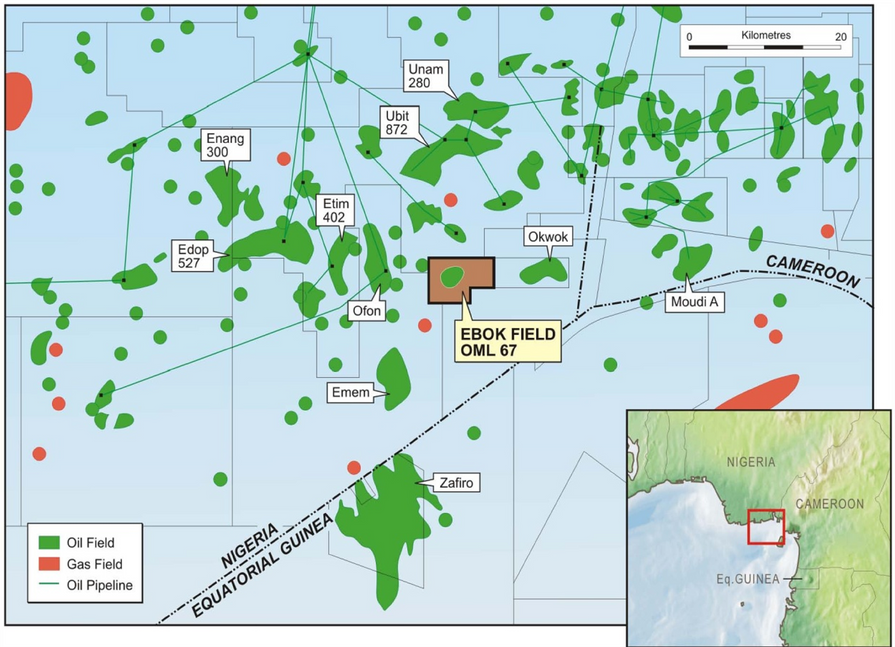
The Ebok Field, currently under production, is located in OML 67, 50 km offshore in 135 ft of water in Nigeria's prolific south eastern producing area. The field was discovered by the ExxonMobil / NNPC JV in 1968 (M-QQ1 (Ebok-1)), and two subsequent appraisal wells were drilled in 1970 (Ebok-2 and Ebok-3). A total of 271 ft. (83m) of net oil pay was encountered in Ebok-1 in four sands between 2,600 ft. (800m) and 3,600 ft. (1,100m); none of the zones were production tested although 24°API oil was recovered from the Ebok-1 well.
The Ebok area is covered with good quality (1992) 3D seismic data and an extensive data set is available for all well drilled to date. Ebok is also located close to several producing ExxonMobil / NNPC JV fields and 55 km south-east of ExxonMobil’s onshore QIT Terminal. The initially estimated mean STOIIP at Ebok (pre 2008/2009 appraisal drilling) was 118 mmbbls of which 25 mmbbls was estimated as recoverable by the Partners.
In March 2008, Oriental signed a Farm-Out Agreement with Afren for them to partner in the development of Ebok.
Further to the Ebok farm out, Oriental has entered into a collaboration agreement with Afren to pursue other potential development assets in the region; which currently includes the nearby Okwok field and the surrounding OML 115 acreage.
Following an announcement in September 2009 that Oriental and Afren had signed a rig contract with Transocean for the Adriatic IX jack-up drilling rig, drilling commenced on 25 September 2009 with the spudding of the Ebok-5 appraisal well and was followed by the drilling of the Ebok-6 appraisal well, after which field development operations commenced in December 2009.
Fast track development solution
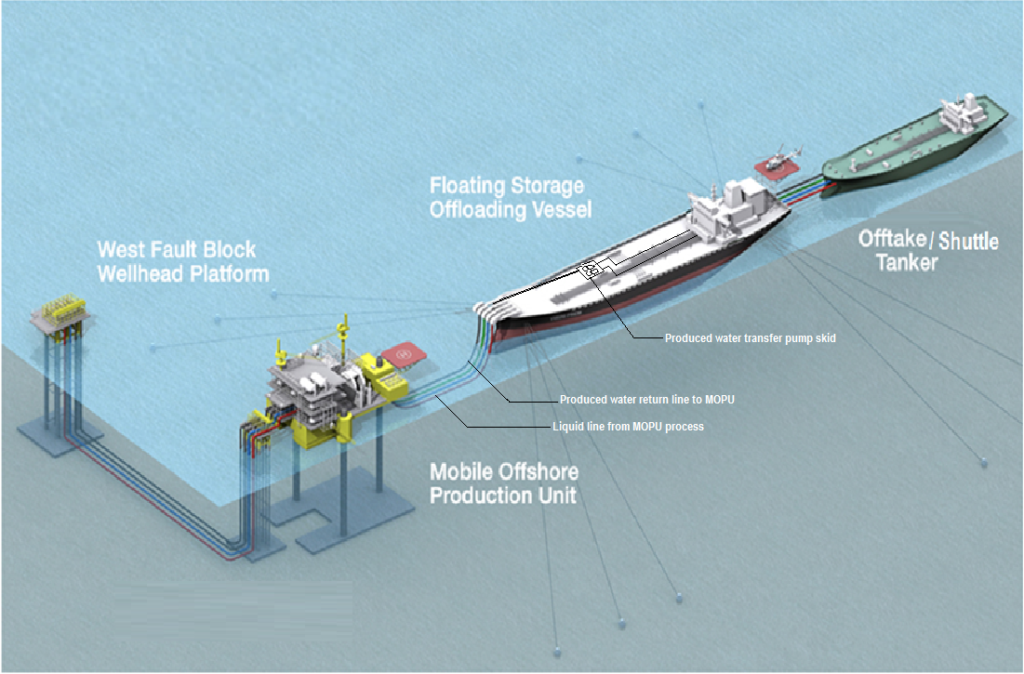
The selected development solution for the field incorporated two un-manned wellhead platforms, one positioned in the Central Area and one at the West Fault Block, tied back to a Mobile Offshore Production Unit (MOPU) where crude oil is processed, from where it is then piped to a Floating Storage Offloading vessel (FSO) spread-moored nearby, where it is stored prior to sale directly into the international market.
The MOPU is a former jack-up drilling rig that has been converted to a production facility by removing the drilling package and replacing it with a processing unit. The facility has the initial capacity to handle oil production of 50,000 bopd, and has been designed to allow for onsite expansion and upgrade to accommodate production from future additional development phases. The advantages of utilizing a converted jack-up were many; the installation of the unit did not require a derrick barge, and it could be installed whilst drilling operations were in progress, allowing for simultaneous installation and drilling with minimal interruptions to work.
The FSO provides a storage volume in excess of 1.2 mmbbls, which allows for the sale of million-barrel cargoes that in turn provide us with maximum flexibility to optimize shipping and crude marketing economics. Similarly, the vessel was converted from a pre-existing tanker; greatly reducing lead times to delivery compared to if a new build vessel was commissioned. Furthermore, opting for the MOPU and FSO development configuration has provided an estimated total cost saving of US$51 million in upfront costs and day rate charges compared to alternative FPSO development solutions that were considered.
Delivering new production
In February 2011, Oriental-Afren successfully installed the production processing and storage facilities and commenced production operations at the Ebok field. The Partners has adopted a phased approach to the field development. The initial phases will access around only 60% of the 2P reserves base established to date, with a rolling development programme planned for the outstanding 2P reserves, in addition to testing the significant upside potential that exists on as yet un-drilled parts of the field.
Field development plan and outlook
The Oriental-Afren partnership has adopted a phased approach to the field development. This strategy will see the proven oil bearing zones brought on-stream, each incrementally adding to production.
The Ebok Development Phase 1 had received development approvals from the Department of Petroleum Resources on 2 October 2009 and commenced in December 2009. The wellhead support structure (WSS) was installed at the field in March 2010, and the Transocean Adriatic lX jack up drilling rig was contracted to drill the development wells. The initial development phase consists of up to six horizontal production wells and one water injection well drilled from one single location in the central Fault Block 1 and Fault Block 2 area of the field. By end 2010, production testing had been undertaken on three of the Phase 1 production wells, delivering a constrained aggregate rate of 12,500 bopd of 24° API oil and demonstrating excellent reservoir properties (porosity of between 30% to 35% and multi Darcy permeability). Together with the remaining production wells these results provide confirmation that the Partners’ production expectation of 15,000 bopd from Phase 1 should be exceeded.
On 23 January 2012, the Partners announced that the initial phases of the Ebok development have been completed, following the commissioning and ramp up of all 14 production wells. Reservoir performance and well deliverability recorded at the field to-date are in line with prognosis, with production processing and regular crude oil off-take operations running smoothly.
The Partners plan to drill up to four further horizontal production wells from the West Fault Block location, targeting oil bearing reservoir zones that were not drilled during the initial phases of field development work. The field partners also plan to drill an exploration well on the Ebok North Fault Block during the first half of the year targeting 35 mmbbls in gross unrisked resources.
Upside potential
The Partners completed an Ocean Bottom Cable 3D seismic survey over the whole Ebok/Okwok/OML 115 area on November 4th, 2011. Having commenced the survey on 24 June 2011, the Partners acquired 348 km2 of high quality data that will assist Oriental-Afren with future development and infill planning at the Ebok field, appraisal and development of the Okwok field and exploration of the highly prospective OML 115 acreage.
As part of the phase 1 drilling campaign, the Ebok-8 water injection well was drilled in August and encountered an additional 100 ft of oil pay in the LD1E sand which was full to base and not predicted pre-drill. Work on development phase 2, targeting the West Fault Block, commenced with an initial batch of pilot drilling that was completed in August. Four pilot holes were drilled, providing important information for future development of the known oil bearing intervals, while also encountering additional oil pay in the LD1F reservoir.
NSAI currently estimates prospective resources at the Ebok field to be 128 mmbbls. Work undertaken at the Ebok field and data obtained from drilling results to date has enabled Oriental-Afren to gain an advanced understanding of the regional geology offshore south east Nigeria and its hydrocarbon potential. This has helped the Oriental-Afren partnership to recognize at an early stage the significant potential that exists at both the Okwok field and OML 115.
Creating a new production hub offshore south east Nigeria
Our development strategy is to systematically bring each proven area on-stream, and through on-going drilling continue to increase the reserves base and production from the field. We plan for the MOPU and FSO to become a central facility for not just the immediately surrounding Ebok structure but also for the broader Ebok/Okwok/OML 115 area, allowing for the economical and rapid tie-back of production from potential future developments on the acreage.
Operation overview
Fast Facts
- First Oil achieved 2011 - Production currently around 38,000 bopd
- Initial phases of Ebok development completed
- 508 mmbbls gross unrisked resource potential